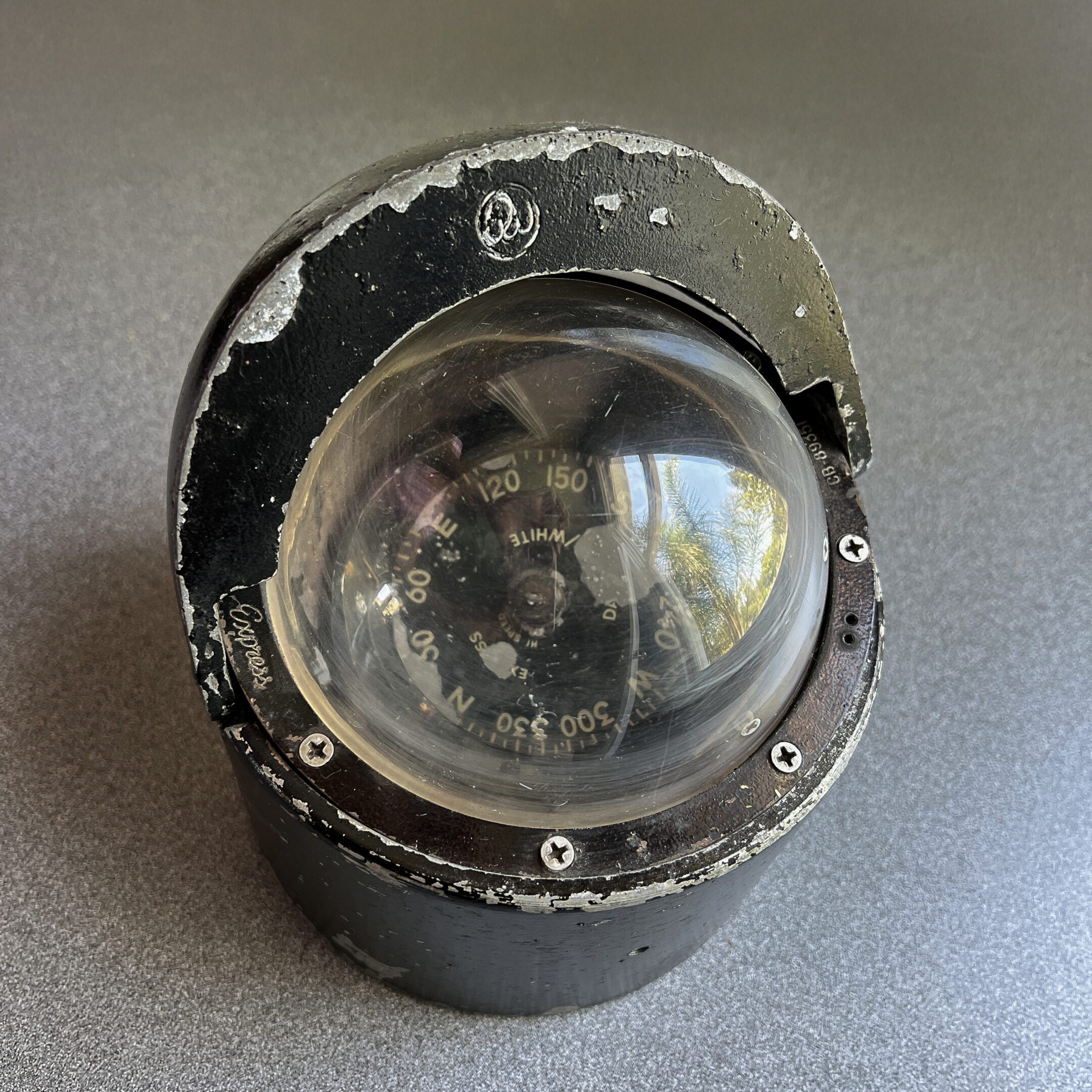
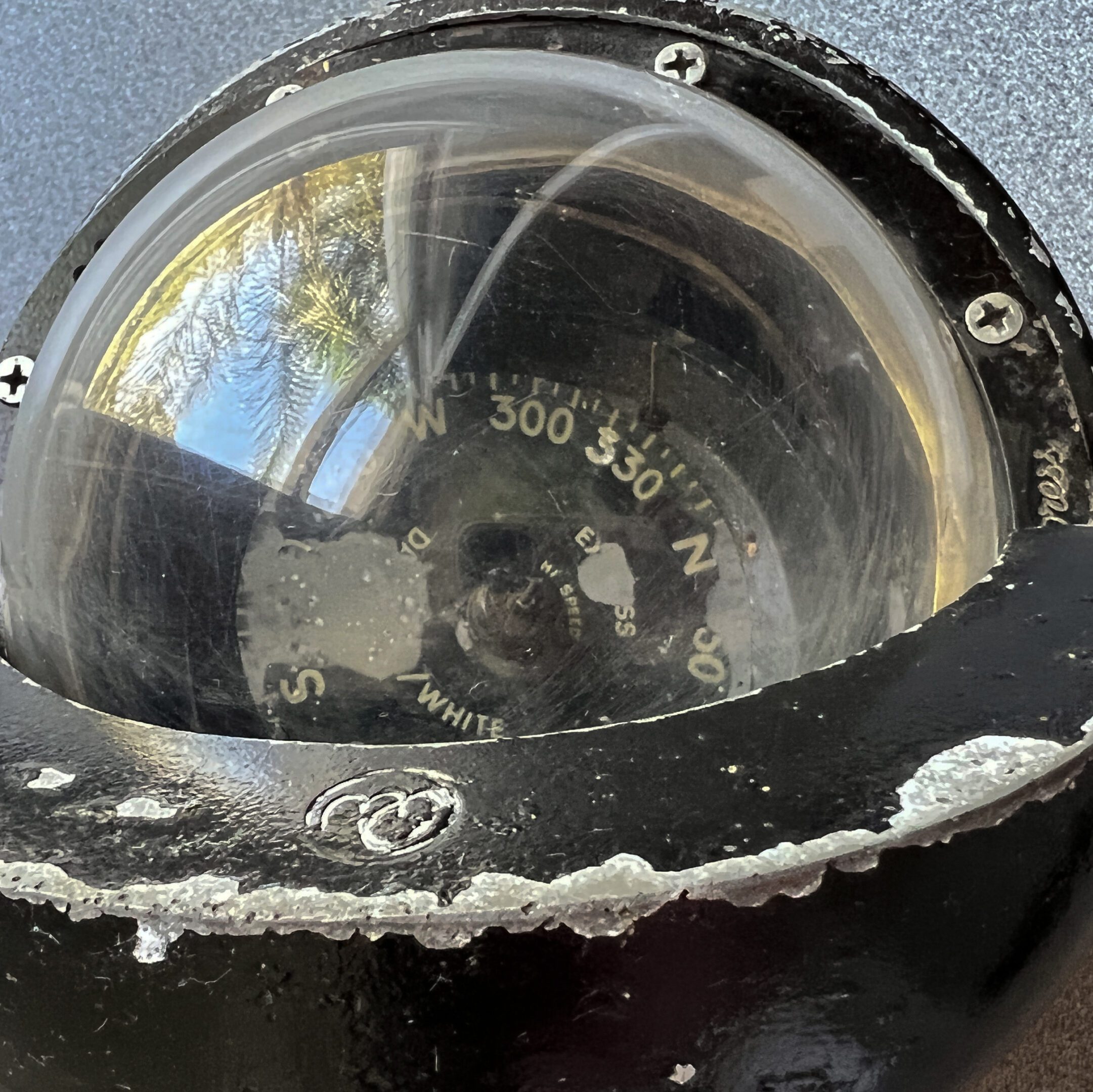
A vintage Danforth-White Constellation marine compass.
The compass was originally designed by the Kelvin-White Company, which was acquired by Danforth in 1961.
The compass is a spherical design, a key invention of the Wilfrid O. White Company.
It is a liquid-filled compass, which can be refilled with a specific compass fluid.
The compass has a serial number stamped on the top bezel ring, with the first two letters "CB" on 5-inch models.
One of the first artifacts that the museum received from the community was this nautical compass. At the beginning of 1980, many people attempted to escape Vietnam by boat. At sea, they went through many tragic experiences, from death to piracy. In San Jose, some Vietnamese doctors closed their practices and volunteered to work aboard rescue ships to save refugees. One of them was Dr. Nguyễn Thượng Vũ. He used the Republic of Vietnam flag as a sign on the ship for the refugee boats to approach. On one of the boats, he saw this nautical compass and took it with him as a souvenir. When he returned, he gifted it to the Museum.
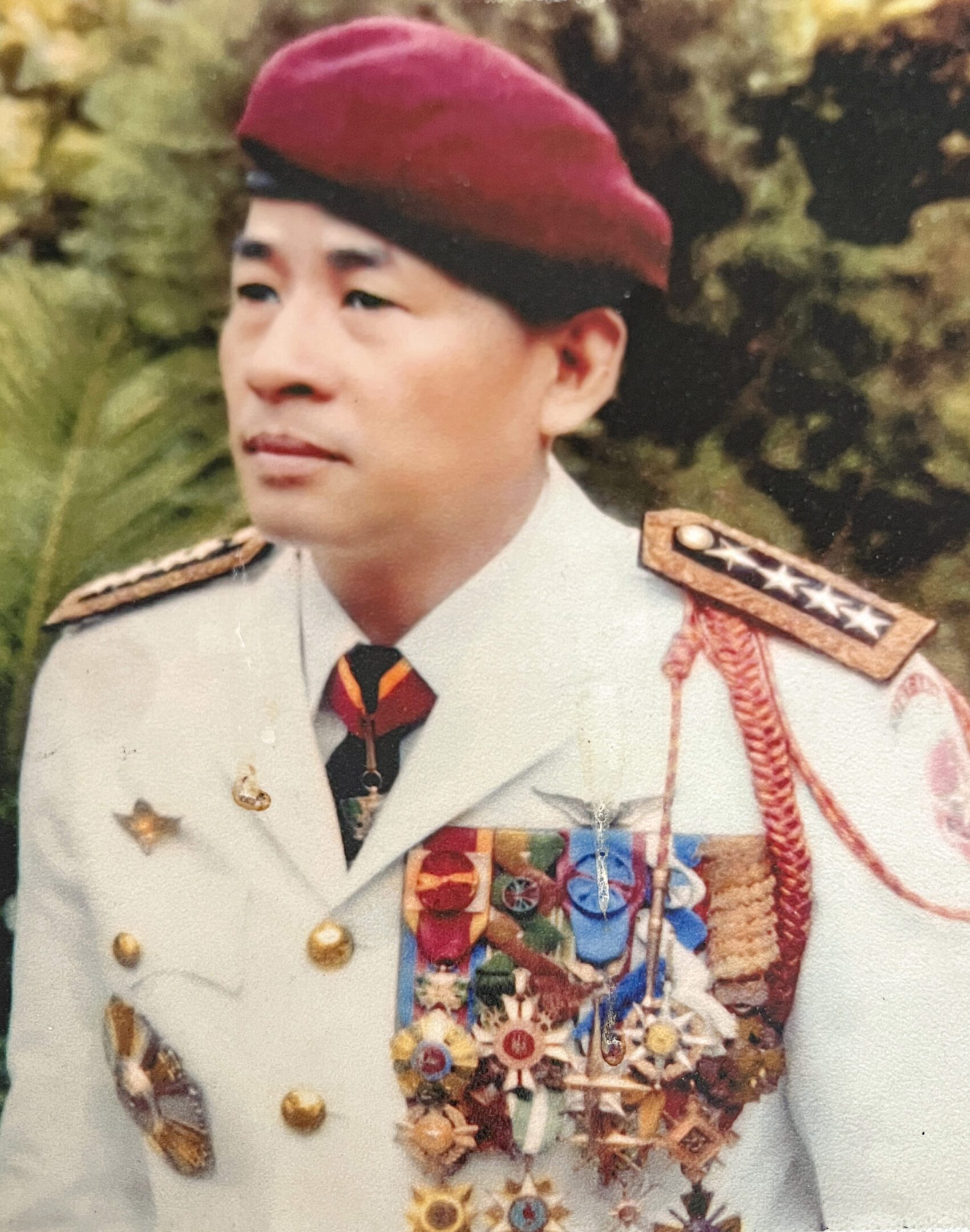
General Cao Văn Viên (1921–2008)
General Cao Văn Viên was one of the most senior military leaders of the Army of the Republic of Vietnam (ARVN). He served as Chief of the Joint General Staff from 1965 to 1975—the longest tenure in that position. Widely respected as a gifted military strategist, General Viên bore the heavy burden of leading an army increasingly constrained by the withdrawal of American forces.
On April 27, 1975, following the appointment of President Trần Văn Hương, General Cao Văn Viên formally resigned and requested discharge from military service. He spent the remainder of his life in exile in the United States, where he passed away in 2008.
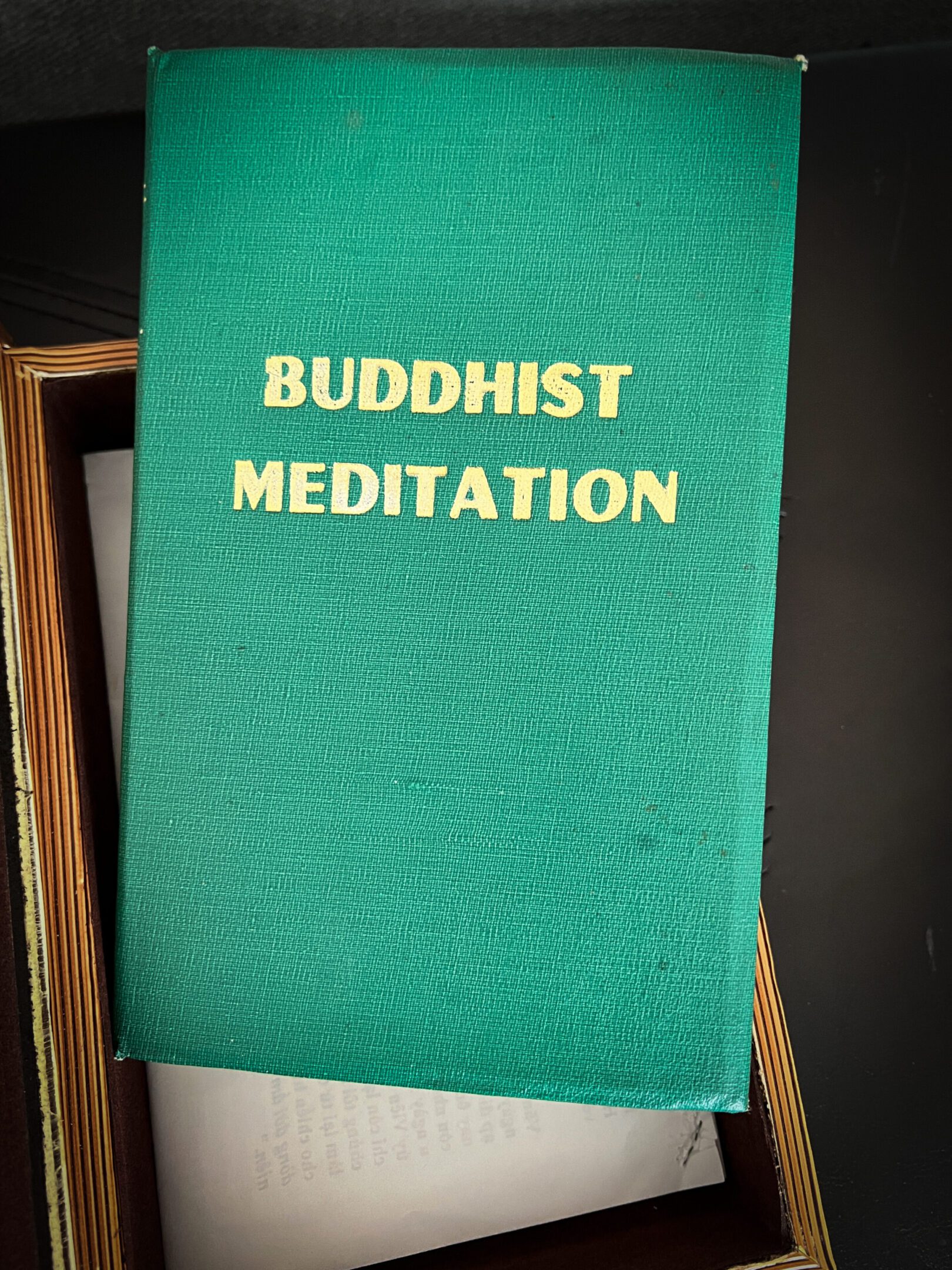
When he left Vietnam, the highest-ranking officer of the Republic of Vietnam Army carried with him only one possession:
a book on Buddhism.
A Personal Remembrance
Colonel Vũ Văn Lộc, Executive Director of the Việt Museum, recalled his final encounter with General Viên:
“I met General Viên only once—shortly before his passing. It was both our first and last meeting.
He said to me with deep emotion:
‘Why was it that when you served at the Joint General Staff, we never met?’
In truth, I had seen him many times—but he had never seen me.”
Decades after April 1975, Colonel Lộc met General Viên again. Holding his hand, he asked a question that many had wondered:
“When you left Vietnam in April 1975, what did you take with you?”
General Viên replied simply:
“I had a leather briefcase.”
Colonel Lộc asked what it contained, hoping to preserve an artifact for the museum.
“There was one book,” General Viên said.
“A book on Zen Buddhism.”
Colonel Lộc asked if the book might be entrusted to the Việt Museum. Months later, Colonel Dương Công Liêm called to say that the book—General Viên’s Zen text—had been delivered.
Legacy
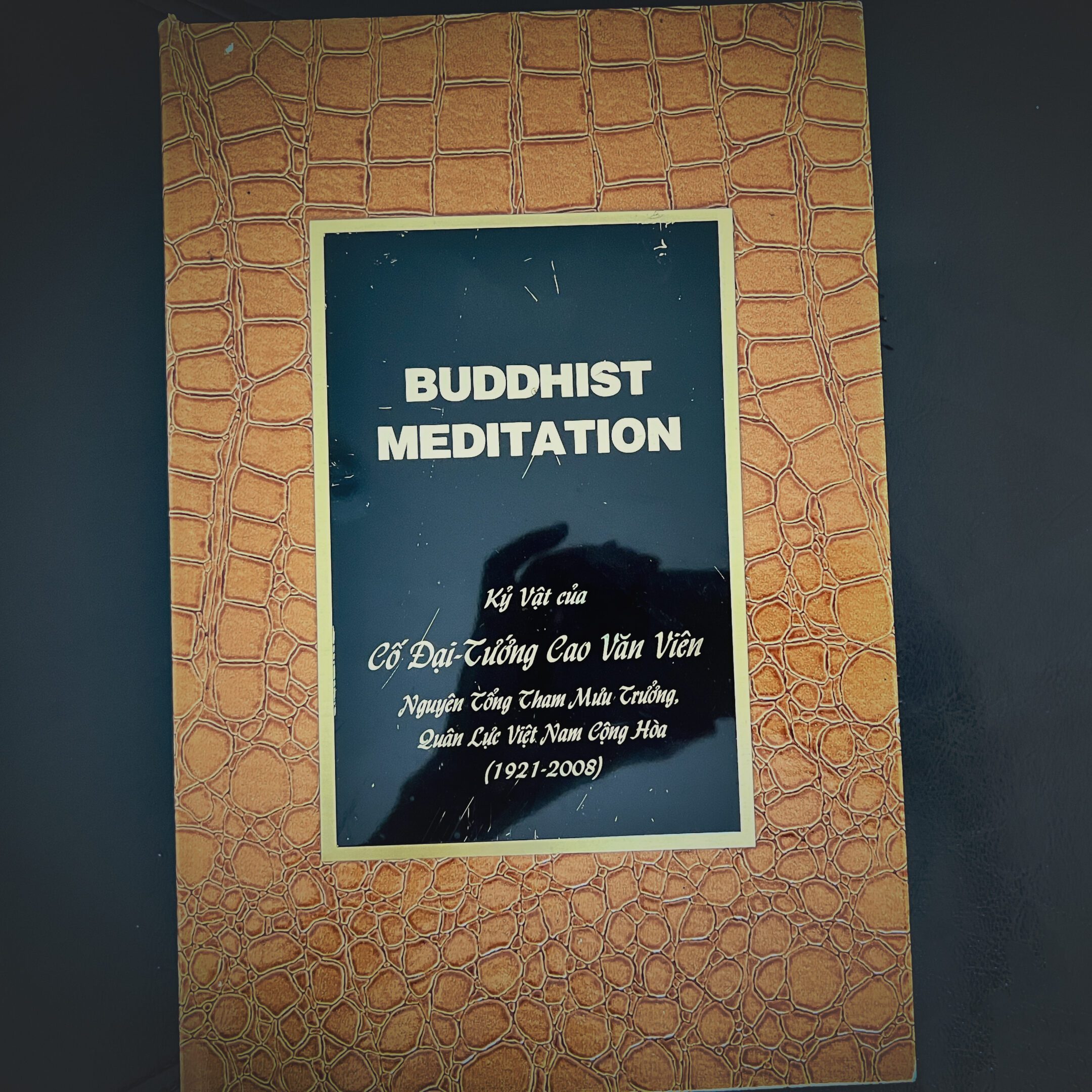
Today, at the Museum of the Republic of Vietnam, alongside the portrait of General Cao Văn Viên, rests a single book—
a book about the Buddhist path.
It invites a quiet reflection:
Why would a general of exceptional ability, holding the highest command of a nation’s armed forces, leave his country with nothing but a book on Buddhism?
In that question lies a deeper truth about duty, loss, humility, and the inner journey taken when all else has been left behind.
President Thiệu's Last Suit
Nguyễn Văn Thiệu (1923–2001) was a South Vietnamese military officer and statesman who served as President of the Republic of Vietnam from 1967 to 1975. He first emerged as a national leader following the 1965 military coup and was subsequently elected president under South Vietnam’s 1967 constitution.
His presidency ended in April 1975, as North Vietnamese forces advanced toward Saigon. On April 21, 1975, President Thiệu resigned and departed Vietnam amid the collapse of the South Vietnamese government. He initially lived in exile in Taiwan, later moving to the United Kingdom, and eventually settling in the United States. He died in Boston, Massachusetts, on September 29, 2001.
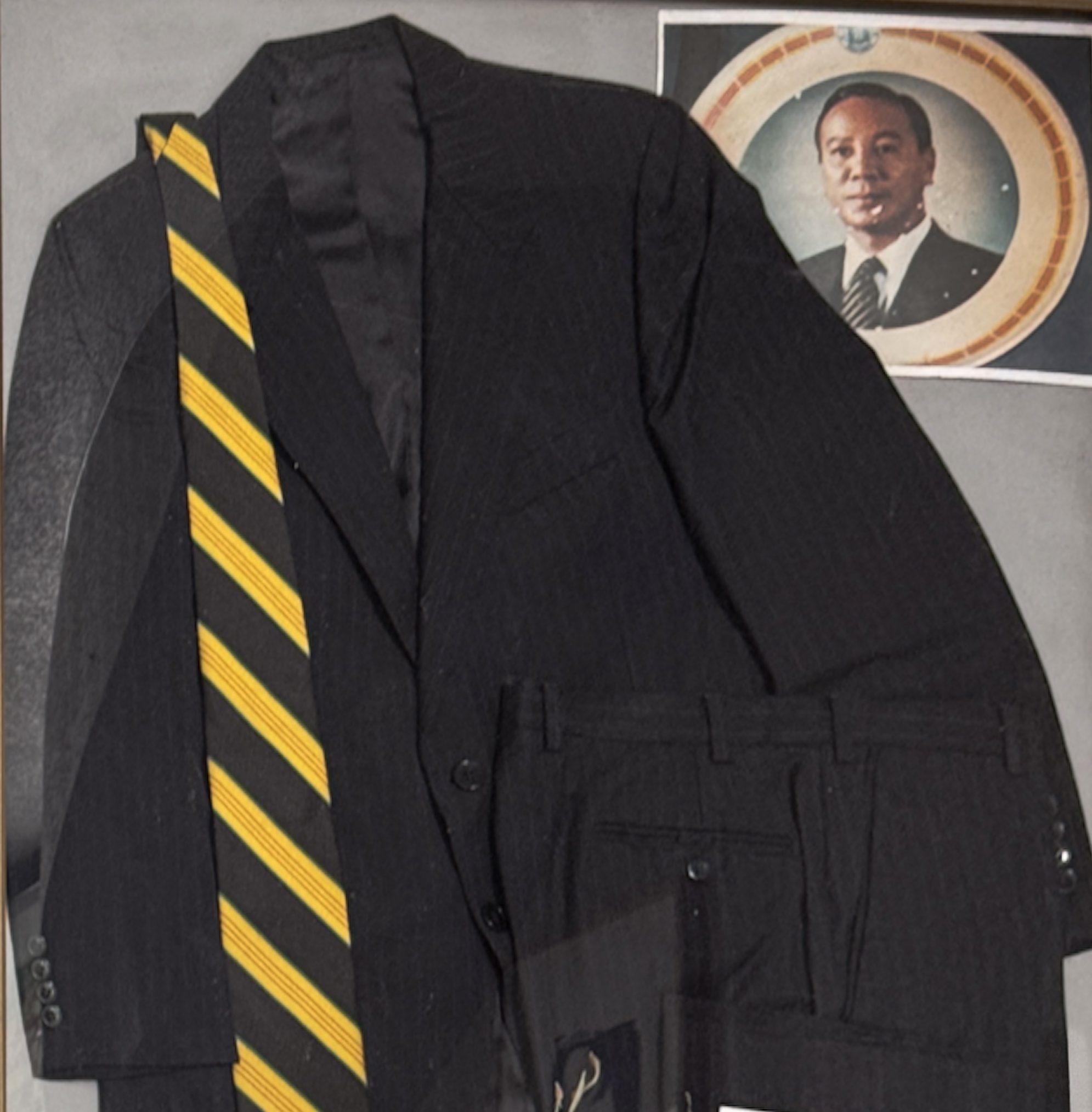
This suit was worn by President Nguyễn Văn Thiệu on April 24, 1975, during his departure from Vietnam. It was later donated to the Viet Museum by his wife, preserving a tangible artifact from the final days of the Republic of Vietnam.
Exodus From Vietnam
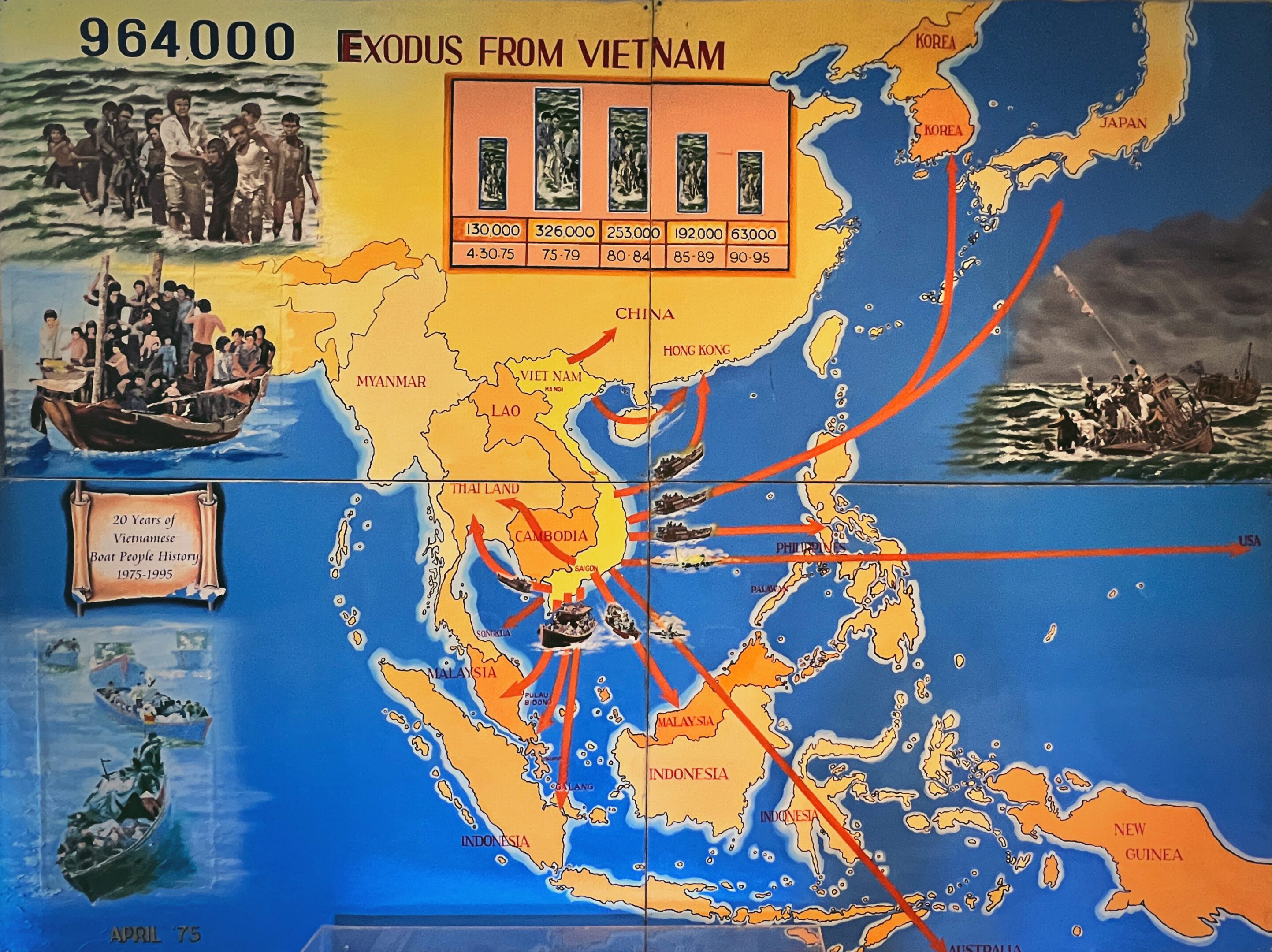
This map depicts the Vietnamese refugee exodus after April 1975, transforming a political collapse into a human geography of flight.
The bold red arrows radiating outward from Vietnam show that there was no single escape route—only urgency. Families fled by land into neighboring countries such as Thailand, Cambodia, Laos, China, and Hong Kong, and by sea across the South China Sea toward Malaysia, Indonesia, the Philippines, and beyond. Many journeys were improvised, overcrowded, and deadly.
The number 964,000 at the top does not represent a moment, but a process—nearly one million people over two decades (1975–1995). The timeline boxes emphasize that the exodus did not end with the fall of Saigon. It continued in waves:
- the immediate panic of 1975,
- the mass “boat people” years of the late 1970s,
- and the slower, grinding departures of the 1980s and early 1990s.
The images of fragile boats juxtaposed with long arrows stretching toward distant destinations underscore a central truth:
this was not migration by choice, but movement driven by survival.
Seen as a whole, the map reframes the end of the Vietnam War. What appears as an ending in newspapers becomes here a beginning—of displacement, endurance, loss, and the formation of a global Vietnamese diaspora.